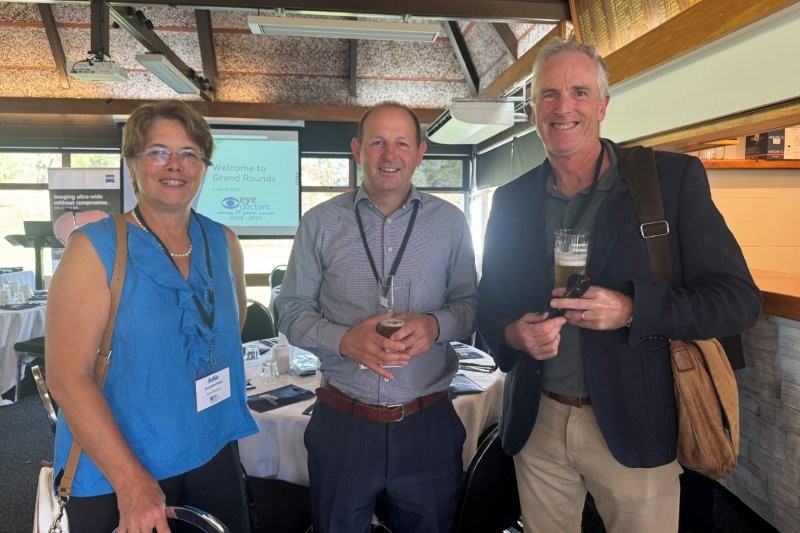







Confession: I have blatantly stolen that heading from this year’s Eye Institute (EI) evening seminar’s MC Dr Peter Hadden (thank you, Peter!). Unlike the film, though, there were no ancient artefacts coming back to life at the Auckland War Memorial Museum on 11 May. Instead, EI offered plentiful talks with lots of useful tips for the attending optometrists.
Understanding and correctly interpreting OCT and fluorescein angiography is key to strengthening optometrists’ ability to provide collaborative care and was somewhat of a theme for the evening. As primary caregivers, optometrists regularly come across intraocular tumours and it’s important to have a simple and systematic approach when dealing with these during examination, said Dr Hadden. While most are benign, he emphasised the importance of distinguishing benign naevi from malignant melanomas such as choroidal melanoma and uveal melanoma. The MOLES scoring system (Mushroom shape, Orange pigment, Large size, Enlarging tumour and Subretinal fluid) is used for triaging in the UK and can be helpful when assessing tumours and flagging high-risk cases for referral to an ocular oncologist.
Dr Sophie Hill dived deeper into imaging with a talk on interpreting macular OCT. Starting with a normal macular anatomy on OCT, she then progressed to recognising scan quality issues and artefacts. Next, using a step-by-step approach and dividing the macular image into sections (inner retina (top), outer retina, choriocapillaris and choroid) she walked through several macular disease cases, locating and describing the pathology and correlating the OCT findings with the clinical findings.
Revealing a new EI service, Dr Hill put the call out to optometrists treating patients living with dry AMD who may be suitable for photobiomodulation (PBM). PBM therapy is thought to act mainly through mitochondrial photoacceptors, particularly cytochrome c oxidase, to improve cell function and reduce inflammation and oxidative stress. With multi-centric clinical research programmes (LightWave I, II and III) supporting PBM for dry AMD, EI is now comfortable it is a clinically safe and effective method, she said.
Little wings
Whangārei-based Dr Stef Guglielmetti covered pterygium grading systems, management and prevention. UVB radiation is the primary environmental driver for pterygium – ‘little wing’ in Greek – and makes prevention in the form of UV-blocking eyewear a key and lifelong practice, he said. Using the Tan morphological classification for corneal invasion (atrophic, intermediate, fleshy) and corneal extension grading (limbus to <2mm onto cornea, 2–4mm onto cornea, >4mm; approaching visual axis, reaching or crossing visual axis) supports consistent documentation and guides treatment decisions, he said.
Conservative management (ocular lubrication with preservative-free artificial tears and viscous gels for overnight use), topical anti-inflammatory agents (brief courses only – monitor IOP), UV protection and six- to 12-monthly review is appropriate for asymptomatic or mildly symptomatic lesions not affecting vision, Dr Guglielmetti said. When monitoring, document pterygium extent at each visit, refer if it’s 1–2mm from visual axis, if there’s a VA drop, if astigmatism is induced or it’s causing contact lens intolerance. Should surgery become necessary, conjunctival autograft remains the gold standard, providing the lowest recurrence rate (2–10%). Full recovery after surgery is about three months, he said, with recurrence most common in the first six months.
Next, retinal haemorrhages came into focus, with Dr Kevin Dunne reminding us the retina is a “window to your cardiovascular health” and that retinal vascular findings can reflect systemic hypertension, diabetes, anaemia, vascular disease and other cardiovascular risk factors. A red alert (bleeding) is an important clinical sign of underlying retinal or systemic vascular pathology and optometrists are often at the frontline of discovery, he said.
Unlike spontaneous venous pulsations, spontaneous retinal artery pulsations - when IOP is high relative to systemic blood pressure - is an abnormal finding that usually warrants investigation, he said. This was the case in one of Dr Dunne’s patients, who had reduced renal function and a history of cardiac disease associated with systemic hypotension and anaemia. These factors contributed to anaemia- and hypoperfusion-related retinal changes, highlighting the importance of considering underlying causes and keeping an open mind when investigating.
Trampolines and cotton candy
Last, but not least, EI newcomer and vitreoretinal specialist Dr Graeme Loh tackled epiretinal membranes (ERMs). Dr Loh studied medicine at University College London, worked as an ophthalmology registrar at London North West and Imperial College, before completing his vitreoretinal fellowship at Moorfields. Prior to arriving in New Zealand in 2025, he spent two years in Alberta, Canada, where he completed a surgical and medical retina fellowship.
Dr Loh described an ERM as a thin fibrocellular layer on the inner retinal surface, uncommon before age 50 but rising steadily after 60 (about 5–10% of adults overall, with a slight female predominance). ERM forms over the internal limiting membrane at the macula and causes traction leading to distortion or reduced vision. Long-term observational studies show that 60–70% of cases remain stable over time; 20–30% slowly worsen over time and 5–10% improve spontaneously. Only a small minority require surgery, but these patients do require monitoring to detect progression and guide timely referral, Dr Loh said.
Consider referral to a vitreoretinal service when the patient presents with visual symptoms consistent with ERM, including blurred or distorted vision (metamorphopsia), difficulty with fine detail or reading, straight lines appearing wavy, objects appearing smaller (micropsia), reduced contrast or visual clarity or, when OCT shows significant evidence of ERM, including central retinal thickness ≥400µm and best corrected visual acuity is ≤6/12 or worse. However, Dr Loh said optometrists can also refer if there are borderline symptoms, diagnostic uncertainty or co-existing pathologies. Ultimately, early discussions help with counselling, monitoring and timing of potential intervention.
Dr Loh also delved into ERM surgery, in which the technique needs to be tailored to the tissue – from the trampoline version of an ERM (tightly adherent and well-organised) to the cotton candy ERM (friable, disorganised). “Know the membrane you are peeling; the goal is not to peel the most but to achieve the best outcome,” he concluded.